Smart bands grow leaner as they mature.
Dinosaur Jr.’s first album, 1985’s Dinosaur, showed a band exploding in all directions trying to find their sound.
Founded in the wake of J. Mascis’ hardcore band Deep Wound, Dinosaur Jr. sought to create “ear-bleeding country” music, but, on their first album created a jumble of hardcore, jangle, cowpunk, and experimental rock. Minus the torrid single “Repulsion,” nothing on Dinosaur would be of much interest to anyone not already riding the Dino bandwagon. The album didn’t sell well, didn’t impress many people, and would’ve vanished if it weren’t for its follow-up You’re Living All Over Me.
On You’re Living All Over Me, Dinosaur Jr. made good on their promise to shred your eardrums. The band sharpened their sound, getting heavier and more concise. They jettisoned most of their smart-assed noise, all of their hardcore yelling, and reigned in their plodding ballads.
Their music expanded like a skyscraper, growing taller instead of wider.
A record of its time and beyond, You’re Living All Over Me proved influential on grunge, shoegaze, and indie rock and is rightly considered a classic, instead of what it also is: a mulligan for their debut.
The Swedish death metal band Entombed don’t have an album comparable to Dino’s debut in their catalog because pundits immediately recognized their debut, 1990’s Left Hand Path, as a classic of the genre.
That’s both a blessing and a curse. On one hand, if you release one heralded album, you’ll always have someone willing to come to your shows. A thousand bands in the first decade of the 2000s released exactly one good album and are still dining out on it today.
On the other hand, no artist wants to do their best work right out of the gate, because where do you go from there?
On their second album 1991’s Clandestine, Entombed followed in the footsteps of most metal bands by making the same music as their debut, but more complicated.
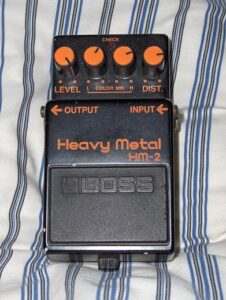
Average song lengths jumped from about four minutes in length on Left Hand to almost five on Clandestine. The arrangements grew more complicated, with Entombed’s signature dual guitars (powered by the so-called “Swedish chainsaw,” a Boss HM-2 distortion pedal with all knobs dimed) finding more complex ways to lock together. And a cleaner overall production allowed the more complex music to hit harder and feel heavier.
Most metal bands simply keep growing in this direction.
Metallica began as a thrash band with Kill ‘Em All, brought on more and more weight and complexity with their second and third albums, and then with …And Justice for All basically became a prog band.
Mastodon did the same thing twenty years after them with Remission through Crack the Skye.
This is the blueprint.
Last week we discussed how music changes when you begin to understand its “rules.” Once you learn music theory, you wanna show it off. And, as much as they’re typically loath to admit, there are no bigger fans of music theory than dudes in metal bands.
Eventually their music becomes so knotty and complex that they have to rein it back in, lest they slide into the prog rock wilderness, exchanging their condoms and Jack Daniels for vape pens and Dungeon Masters’ Guides.
By their fifth or sixth album, your typical metal band is ready for their return-to-basics reset.
Enter: Metallica’s self-titled “Black Album” or Mastodon’s less successful bid for mainstream attention The Hunter.
With these “reset” albums, their bands strip back their songs’ complexity, try out a poppier producer, and try to win back some of the women they lost from their audience when they were writing bridges in 13/8.
Typically these “reset” albums expand a band’s audience at the expense of their most diehard fans, who seemingly always want their metal bands to get harder, more complicated, and less popular.
The fourth or fifth album is when most bands hit their first unavoidable no-win scenario. Their Sophie’s choice seems to be to either artistically plateau to keep your diehards happy, or strip back for a pop push and potentially lose the diehards.
Entombed short-circuited that traditional career trajectory by declaring Clandestine their prog album, and their third, 1993’s Wolverine Blues, as their back-to-basics reset album.
But Entombed went harder than a factory reset, they basically reinstalled a new operating system. For while Wolverine Blues is as death-obsessed as anything off of Left Hand Path, the music feels, gasp, like hard rock more than death metal.
For Wolverine Blues, Entombed channeled the then-hot groove metal of Pantera, cleaned up their vocals, and scaled back their tooth-chipping tempo shifts and chest-rattling blast beats. I daresay, someone raised on Metallica instead of Florida death metal and Norwegian church-burners might actually consider Wolverine Blues palatable
Of course many of Entombed’s diehards considered Wolverine Blues a sellout move, but plenty others fell in love with their new stripped down sound. So much so that a new genre arose in the album’s wake: death ‘n’ roll (I didn’t say it was a good genre).
Fellow death metal acts like Carcass and Gorefest followed suit, releasing death ‘n’ roll albums of their own in the 1990s. Now Wolverine Blues’ hard rock variant of death metal is another color in the putrid spectrum of the death metal rainbow.
I feel that it’s valuable to understand the history of music (duh, that’s pretty much what this column is about), but it’s more important for a band to follow their own muse. Sometimes that means making a your prog metal album. Sometimes it means making your back-to-basics reset album early.
Entombed broke the mold and in the process created a new genre. Not bad for their third album.