This week we’re continuing our tour through Treble’s list of their 50 favorite post-punk albums of the 21st century.
Have a Nice Life – Deathconsciousness (2008): I didn’t think I would like Have a Nice Life’s Deathconsciousness. First off, there’s the name. “Have a Nice Life” is too jokey, and “Deathconsciousness” is too emo.
And then there’s the length. Thirteen tracks weighing in at over eighty minutes. Punk was supposed to kill that shit. You could play Minor Threat’s “Filler” almost four times in the time it takes to play the average-length Deathconsciousness song. (Eight times for the epic closer “Earthmover.”)
Don’t judge a book by its cover.
Actually, go ahead.
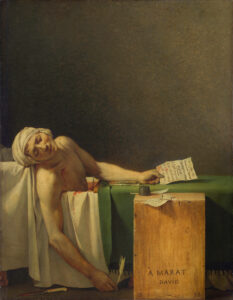
Besides the band name and album title, I quite like how the band repurposes Jacques-Louis David’s The Death of Marat for their cover art. (But keep in mind that I stole a Caravaggio for Heck Reckoners Bandcamp page, so….) Painted during the French Revolution, The Death of Marat depicts the assassination of Jacobin Jean-Paul Marat, portraying him as a martyr. By cropping the painting and bumping its contrast, Have a Nice Life transform the tableau into a suicide. The band effectively takes a piece of political art and makes it personal.
The story of the making of Deathconsciousness is just as compelling as the artwork. Motivated by the death of his father, Dan Barrett teamed up with Tim Macuga and recorded Deathconsciousness over the course of five years.
A DIY project in the purest sense, two men, compelled to make art in their spare time to deal with their emotions, without the backing of anyone in the music industry, made a word-of-mouth classic that, twenty years later, is recognized as among the best in the genre.
None of that would matter, of course, unless the album was actually good. And, I think, it’s pretty, pretty, pretty good.

Most albums feel constructed, built from the ground up like a house, but Deathconsciousness feels like it was unearthed, painstakingly chiseled, dug, and dusted.
The songs go long, but they’re all in service of a cohesive mood. We’ve talked about “song” bands and “vibe” bands before, and Have a Nice Life vibe like a Hitachi Magic Wand.
Most remarkably, despite the album’s DIY origins, nothing on it feels out of place. Have a Nice Life brings in a half-dozen genres – ambient, shoegaze, industrial, goth, experimental, post-punk – and makes them coexist in a hazy, foreboding, lethargic stew. Even the albums’ rudimentary drum tracks feel of a whole.
It’s a remarkable album, and one that I’m happy to welcome to my life.
Besides, I’m a sucker for the story. As someone who’s currently part of two such projects, I can’t help but love when a couple kids get recognized for their evenings-and-weekends art project.
A Place to Bury Strangers – Exploding Head (2009): Oliver Ackermann is probably as famous for his pedal company Death By Audio as he is for his band A Place to Bury Strangers. That seems fair, because his band seems as much like a showcase for his pedals as they are a conduit for his songwriting.
A Place to Bury Strangers traffic in noisy garage rock, for those who like more hiss, screech, and whooom with their four-chord stomp.
A typical APTBS song begins at medium noise, blows up to big noise for the chorus, goes back to medium noise, and then explodes to big noise again at the end. All the lyrics are delivered in the same monotone Jesus and Mary Chain drone, but the magnificent guitars pull from every corner of the distortion spectrum.
Whenever I listen to A Place to Bury Strangers, I wonder if I should just pare my pedalboard down to eight or nine fuzzes and overdrives.
The Horrors – Primary Colours (2009): Last week I said that one of the reasons I love post-punk is that its bands aren’t typically in it for fame. The economics just don’t work out. You just ain’t gonna get huge making music that not that many people listen to.
That said, I can’t quite explain the Horrors. They began as a goofy garage rock band on their debut, found success as a Joy Division-indebted post-punk band on Primary Colours, and then launched into the stratosphere with their next album, the swirling, overly reverbed Skying, which feels like a genre of indie pop rock.
Despite my ambivalence for their later work, The Horrors of Primary Colours show a band that’s so confident in their sound, I’m amazed post-punk was only a pit stop for them.
“Mirror’s Image” and “Who Can Say” are like what New Order would’ve sounded like with Ian Curtis fronting, “Three Decades” recalls the first wave of New Zealand’s indie rock but with more depth to their sound, “New Ice Age” is Wire with more reverb, and the romantic gloom of “I Only Think of You” is pure Cure.
Maybe I’m thinking about careerism wrong. Maybe every band with giant aspirations should take a swing at creating an album for the artsy weirdos. It would be like the opposite of when an artful director makes a genre movie. Maybe music would be better if Prince made a punk album or Springsteen worked with John Lydon. (Hell, he made one of his best albums ripping of Suicide.)
HTRK – Marry Me Tonight (2009): On Marry Me Tonight, HTRK make sexy, sub-zero industrial music that’s both enticing and off-putting. With little more than an 808 set on “glacial,“ load-bearing basslines that are occasionally funky (though often not), guitar that could be described as “ambient rhythm,” and Jonnine Standish’s sad, seductive vocals, HTRK construct a world of menace and ennui.
This is ESG on quaaludes.
Women – Public Strain (2010): In the 1990s, it was Guided by Voices and Sebadoh. In the 2000s, it was Women. Now it’s Sharp Pins. Just as every new generation thinks it invents sex, every new generation thinks it invents lo-fi music.
I believe the recent success of Women frontman Patrick Flegel’s Cindy Lee has brought new fans to this Canadian outfit’s psychedelic post-punk. Rightly so.
Women make attenuated pop music, like they dissolved the Beach Boys, the Velvet Underground, and This Heat in a vat of acid and made a new record with the juice.
Bradford Cox, who made similar-sounding music contemporaneously, said of Women, “I couldn’t come up with music like that if my life depended on it.” Me neither. Women string bits of guitars, vocals, and gentle waves of distortion together into music that is as much cloud as song.
A layer of reverb or delay always keeps listeners at a distance, as if there’s a sheet of radio static to keep them from rocking out or feeling too deeply.
This is perfect music for a generation on SSRIs. “Do everything,” Dry Cleaning said on “Scratchcard Lanyard,” “feel nothing.” One hundred percent goddamned right.