Whenever I get a band together, I always push for our first release to be an LP rather than an EP.
Part of that is that we, as a culture, don’t take EPs seriously. Spotify and Allmusic.com lump EPs in with the singles, music journalists tend to leave them off their year end lists, and record labels don’t like spinning up the PR machine for “minor” releases.
Part of it is that while there are many successful bands who released a single LP before breaking up (The Sex Pistols, Derek and the Dominos, Jeff Buckley, Life Without Buildings), absolutely no one released only an EP that later made a dent in culture. (Sorry, The Nerves, you would’ve made the list, but you later cut a real record.)
So, that’s my hedge against failure. If my band is only going to get one release, you better believe it’s going to be the full-calorie version.
That said, I really like so-called Extended Players, and I wish we treated them more seriously. So today we’re going to take inspiration from Paste’s 100 Greatest EPs of All Time list and do just that.
Typically bands release EPs for one of five reasons, and we’re going to look at each of them.
THE DEBUT EP:
The most common type of EP is the debut. A new band forms, their sound coalesces, and they want to share their music with the world as fast as possible. Cranking out a fifteen minute EP requires a lot less work (songwriting, practice, recording) than releasing a forty minute LP.
But it fulfills the very same function.
Most bands form and break up before they release anything. Releasing an EP puts you on the map and gives you credibility. With an EP in your hand, you’ve an opportunity to open a Bandcamp account in your name, claim your band name on the streaming platforms, and give bookers a reason to book you. Instead of only telling people what your band sounds like, you can show them.
The Pixies said they made music like Hüsker Dü and Peter, Paul and Mary, but what the fuck does that mean? If you can share Come on Pilgrim – which sounds somewhat like Hüsker Dü; barely at all like Peter, Paul and Mary; and like nothing else that came before it – you don’t need to explain yourself anymore. What do the Pixies sound like? In 1987, the Pixies sounded like Come on Pilgrim.
Some, like R.E.M.’s Chronic Town and Buzzcocks’ Spiral Scratch, show bands that arrived on the scene fully formed. Some, like Fugazi’s self-titled and Mission of Burma’s Signals, Calls and Marches, contain songs the bands would play for the rest of their careers. And some, like Mudhoney’s Superfuzz Bigmuff, became the archetype for an entire genre of music.
THE TRANSITIONAL OR EXPERIMENTAL EP:
It’s jarring when a band switches directions. It’s jarring for their fans, of course, but it’s also jarring for the band itself. In fact, it can be as difficult for an existing band to change their sound as it would be to form a new band altogether.
There’s also the great possibility that a band will try a new sound and fall flat on their face. Some bands have the elasticity, chops, and imagination to evolve. Some do not. Writing and recording an EP allows a band to try out their new sound without all the expectations and scrutiny that come with releasing a full-fat LP.
Sometimes they produce some of the band’s best material.
My favorite Nine Inch Nails release is Broken, a guitar-heavy EP the band recorded between the synth-goth of their debut Pretty Hate Machine and the blockbuster industrial rock of The Downward Spiral.
While casual fans were no doubt blown away by how huge the band sounded between their first album and their second, Nails fans knew Spiral’s heaviness was just an extension of Broken’s.
It’s so stupid to me that NIN’s hardest rocking song “Last” can only be found fourteen (!) records deep on Spotify’s EP tab.
The only EP to debut at #1 is Alice in Chain’s gorgeous Jar of Flies. Between pummeling LPs full of pounding drums, distorted guitars, and lyrics about the ravages of heroin addiction, AIC released a series of EPs full of jangly guitars, stirring harmonies, and lyrics about the ravages of heroin addiction.
Their EPs, Sap and Jar of Flies, proved the band had a whole other folky side that fans of their grunge rock could either take or leave.
Norway’s Ulver always saw themselves as more than a black metal band, but they notoriously shifted away from using rock instruments altogether on 1999’s Metamorphosis, which presaged their outright evolution into a trip-hop (!) band for next year’s Perdition City.
In Metamorphosis’ liner notes, Ulver acknowledged their relationship to black metal, but described it as “stepping stones rather than conclusions,” and advised listeners to “please have the courtesy to refrain from voicing superficial remarks regarding our music and/or personae. We are as unknown to you as we always were.”
So I guess I’ll stop talking about them now.
THE COMPANION EP:
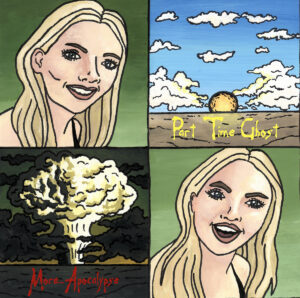
Part-Time Ghost has an EP coming in the near future. It’s the first EP I’ve ever released. And it wouldn’t exist except that, well, we had too many damn songs for Apocalypse Now-ish.
It’s not that the five songs on our upcoming EP, titled More Apocalypse, are worse than the songs on Apocalypse Now-ish, it’s that putting them on Apocalypse Now-ish would’ve made that record worse.
Whether it’s a record, a concert, or a romantic coupling, it’s always better leaving them wanting more instead of less.
And…maybe some of the songs are a little worse. You could write the shit out of a song and it might still not come together while recording it. But that’s not to mean that you don’t love it, or want to share it. You just might not want the exposure it gets as part of an LP.
And that’s where EPs come in.
They can be a clearing house for material that would make an LP run long, is flawed in some way, or doesn’t fit on an LP sonically or thematically.
To this day, I regret not leaving a song or two off of Heck Reckoners’ Touch Grass. It’s too long at 50-some minutes and, despite the fact that I like them, the two acoustic tracks really don’t fit with the rest of the rocking punk.
They would’ve been perfect on an EP.
Among famous bands, I really like companion EPs like Pavement’s Watery, Domestic which pairs their noisiest material (“Texas Never Whispers”) with some of their poppiest (“Frontwards,” “Shoot the Singer (1 Sick Verse)”), Archers of Loaf’s Vs. the Greatest of All Time which basically does the same thing, and Modest Mouse’s Interstate 8, which was just a way for a band who already made long albums to release more music.
THE EP THAT’S REALLY AN LP:
Paste awarded Sufjan Stevens’s All Delighted People as the #1 Greatest EP of All Time. Uh…except that it’s not an EP.
Sure, when he released it in 2010, Stevens touted the 59-minute-long (!!) record as EP, but he also told the music press that he was going to release an album about each of the fifty states. So far he has written two.
What I’m saying is that Stevens knows how to hook journalists and calling an EP that’s really an LP is a good way for them to find their way into their article about you.
But I know that even Stevens doesn’t consider All Delighted People as an EP, because on Bandcamp he’s selling it for $10, the same amount as its mother album, The Age of Adz.
Don’t be fooled. This is like when lead actors submit for the best supporting category in the Oscars.
BANDS WHOSE LPS SHOULD ALL BE EPS:
My favorite Dillinger Escape Plan record is their 2002 one-off with Mike Patton on vocals called Irony is a Dead Scene. It’s not so much the Faith No More singer’s contribution (although he’s a perfect fit with their abrasive mathcore), as it is the album’s length.
The Dillinger Escape Plan is a painful band to listen to for more than twenty minutes. Their jagged guitar runs, harmonized flat seconds, abrupt tempo and time changes, and screamed vocals become oppressive for the length of a traditional LP.
Ironically, music that was supposed to challenge every norm ends up feeling monotonous.
We’ve discussed before that the ideal length for an album is 35-45 minutes, but that’s a little long for hardcore punk, grindcore, metalcore, math rock, genres that typically work best in fun-sized bites.
Fortunately, newer bands, such as Nashville’s Thirdface, are proving that you don’t need to pass the 30-minute line to provide listeners with a complete music experience. At 20:11, their 2024 album Ministerial Cafeteria provides twelve blasts of their grindy, shouty hardcore. It’s short, it’s perfect, and it ain’t a damn EP.