One of the most punk rock things a punk rock band can do is deny their punk rock audience punk rock music.
By the early 1980s, the punk rock revolution that had begun a half decade earlier as an artistic free-for-all had begun calcifying into a genre. Where earlier punk rock brahmin saw The Ramones’ songs as one potential strain of future music, new “hardcore” punks saw them as a good starting point, if, quite frankly, a little slow and a little sloppy.
As the hardcore scene got younger and more “hardcore,” the music got faster and louder, and, let’s be real, dumber and monotonous.
Considering many of the scene’s vets were drawn to punk rock for its oppositional nature, they began playing their new music slower and looser for audiences that were expecting it to be faster and tighter.
Flipper, Fang, and My War-era Black Flag kept punk’s puckishness, anxiety, and practiced amateurism, but dialed down its tempos.
Today we celebrate the genre that sought to create an impossible music, slow hardcore, and, in the process, created one of the wooliest, wildest metal genres: sludge.
We’re using Kerrang’s 2020 list “The 13 Most Essential Sludge Records” as a jumping off point.
New Orlean’s Eyehategod is the most essential sludge band, and their 1993 album Take As Needed For Pain is their most essential release (though its follow-up Dopesick is probably the band’s definitive statement).
More than anyone on this list, Eyehategod concocted sludge’s recipe: plodding pace; gooey dollops of downtuned guitar; lyrics about mental illness, drug addiction, and self-loathing; actual mental illness, drug addiction, and self-loathing; guitars so distorted that they make noise even when they’re not being touched; found sound interstitials; a tenuous connection to 1970s rock music (in Take as Needed’s case, southern rock); and an overall ambience of filth, poverty, and decay.
Not that it matters (but it does just a tiny bit), Eyehategod’s band members’ hard-living lyrics weren’t a put-on (maybe “Sister Fucker, Pts. I & II’s” were), as the band collectively has more arrests, overdoses, comas, Lazarus-style rebirths, organ transplants, and early deaths as any other band in their weight class.
Like how black metal isn’t necessarily synonymous with church-burning, sludge isn’t necessarily synonymous with bad living, but in Eyehategod’s case, it kind’ve is.
Despite listening to a type of music that 90% of people couldn’t give a shit about, metalheads are pretty particular about where their favorite band falls on metal’s genre spectrum (probably because metalheads themselves disproportionately fall somewhere along a spectrum).
If sludge’s parents are Black Sabbath and hardcore punk, their siblings are doom, grunge, stoner rock, and progressive metal. But Iron Monkey throws a wrench into that construct by basically having, essentially, a black metal singer, since Johnny Morrow sings like a Norwegian atheist.
That said, the music on Our Problem is straight sludge. Unlike Eyehategod, Iron Monkey are probably more concerned with rocking than conveying (and inflicting) pain, but they still build songs out of bluesy shrapnel and lethargic drumming.
“9 Joint Spiritual Whip” goes for 19 minutes, but ten of those minutes are dedicated to how to finish the song. It’s their best.
As a dedicated adherent to the Church of Matthew Pike, I have a hard time considering his music as part of any genre.
At its core, I guess High on Fire is a sludge band. But that kind’ve sounds like calling Motörhead a rock & roll band. It’s like, yes, but it kind’ve misses the point. To me, no one else in rock is more adept at running down their muse while staying in their lane than Pike, and 2000’s The Art of Self Defense is the first step on High on Fire’s idiosyncratic journey.
Unlike other sludge monsters, High on Fire never let their foot off the gas. They barrel through five- to ten-minute songs like a tractor-trailer ripping through backroads at ten over the speed limit. It never feels like they’ll lose control, but their energy never flags either.
Like all of Pike’s lyrics, Self Defense’s are more concerned with aliens, conspiracies, samurai, and the Middle East than sludge’s bread-and-butter of self-harm and drug consumption, but this is what he looks like on stage:

You could sell this as the “Sludge Musician” action figure and charge an eighth for it.
I would say that sludge is kind’ve the fuckup brother to grunge, but that’s like saying Stephen Baldwin is the fuckup brother to Alec. I mean, it’s true that one is way more successful than the other, but both of their personal lives seem pretty gnarly. While grunge and sludge both traffic in downtuned guitars and opiates, only one genre sold millions of albums.
With their ‘70s rock sound and relatively crisp production, the Crowbar of Odd Fellows Rest may well have the most commercial sounding album on this list. Hell, “Intro” features harmonized lead guitars and organ, and the album’s biggest hit, the perennial live favorite “Planets Collide” is a ballad!
Crowbar makes music about a life that seems hard, but, compared to the broken Lego pieces that Eyehategod force feeds you, this is practically easy listening. Seriously, plug them into a playlist next to Alice in Chains and Tad. Who’ll blink?
I don’t really think of Neurosis as part of the sludge ghetto. Ever since they expanded beyond their hardcore roots in the early ‘90s, they seemed to have higher artistic aspirations than your regular life-hating sludge merchants. Besides, how many sludge bands include both someone on synthesizers and samplers, and a dedicated visual artist?
Through Silver in Blood is one of the first and most important post-metal albums of all time (the UK’s Fact magazine named it #1) but I wouldn’t necessarily consider it sludge. Don’t get me wrong, you could cue “Eye,” the album’s shortest actual song at 5:17, and slot it between Crowbar and Acid bath on your “Baby’s First Sludge” playlist, but there wouldn’t be any room for any of Through Silver’s five (!) other ten-minute epic tracks.
Neurosis is metal for people who wished Swans went longer (which they eventually would) or people who wished Godspeed You! Black Emperor went harder. They’re also the only band on this list that features bagpipes.
For Melvins, I actually would’ve gone with Bullhead or Gluey Porch Treatments instead of their major label debut Houdini (the band jumping from the label Boner to Atlantic/Warner Bros is like going from single A ball to the MLB).
Don’t get me wrong, Houdini has some of the band’s best material (“Honey Bucket”, “Hag Me,” “Night Goat,”), but their influence had already spread far and wide by the time of the 1994 release. Pantera’s Phil Anselmo, a fixture of the sludge scene, said that it was, “when the Melvins came out with their first record, [1987’s] Gluey Porch Treatments, it really broke the mold, especially in New Orleans. People began to appreciate playing slower.”
Despite their moderate success, Melvins are one of the most influential bands in heavy music. Grunge bands copied their heaviness and sludge bands copied their heaviness and tempos. But few bands copied their weirdness – or their prolificacy (26! studio albums).
Although we’re calling Houdini sludge, only half of its tracks count as such. The rest are experiments, from “Teet’s” industrial grunge, to “Compche’s” Scratch Acid tribute, to the sickly lounge jazz of “Sky Pup” to the interminable drum circle close “Spread Eagle Beagle.”
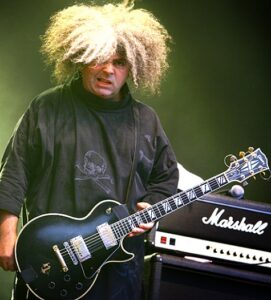
Also, I don’t know if you can be sludge if you look like Sideshow Bob:

Next week: Mastodon, Acid Bath, more.