The last adult pictured in Art Kane’s iconic 1958 photograph A Great Day in Harlem, the saxophone colossus Sonny Rollins, died earlier this week at 95, thus closing a chapter when jazz was not only one of the critically exalted, but most popular, artforms.
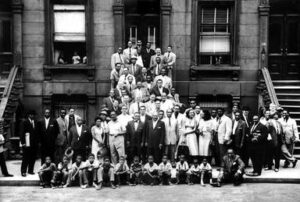
Time moves relentlessly forward, flattening the flesh-and-blood humans like Charles Mingus, Thelonious Monk, and Mary Lou Williams who came out to be photographed on that summer day into “icons,” inevitably erasing much of their humanity.
It’s one thing to read about Monk, it’s another thing to know him, and the people who knew him, since his death in 1984, are growing fewer and fewer every year. (One of those people was Rollings, for whom Monk played as a sideman on his own composition “Misterioso” on Sonny Rollins, Vol. 2 in 1957).
When an icon passes, we always say that they’ll be with us forever. And that’s true, but it’s also cope. The giants of old grow smaller as time passes, as more culture gets heaped upon the pile, as the people who cared the most pass and get replaced by people who care just a little less.
Before jazz, the most popular music in America was march music, as typified by the “March King,” John Phillip Sousa.
Name one other famous march composer.
I rest my case.
A famous quote that I can’t find solid attribution for – we’ll just give it to Shakespeare and Abraham Lincoln – says that you die twice. The first time is when your body dies, and the second is the last time someone says your name. So… you should think about that when you’re trying to get to sleep on a work night.
Now, there are plenty of people that we haven’t forgotten yet even though they were born thousands of years ago – Alexander the Great, Cleopatra, and Neithhotep, a Queen’s consort from 3050 BC, who’s the oldest named woman on historical record. But it’s a microscopic sliver of the people who ever lived, and includes nobody before 5,000 BC. That’s right. Humans existed biologically and behaviorally for 90% of our ongoing run before we decided to remember any singular person.
So take it as a given that nothing lasts forever. Even the ever expanding sphere of radio waves that our planet has broadcast into the universe since 1895, the entirety of our transmittable culture, gets obliterated by space-borne radiation before it could potentially be deciphered by intelligent extraterrestrials. Digital ashes to digital dust.
However, Sonny Rollins has a leg up on Neithhotep, Alexander, Shakespeare, Lincoln, and even John Phillip Sousa.
Because we recorded Sonny Rollins.
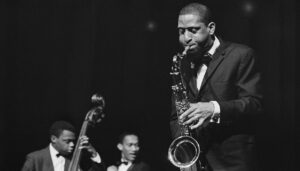
We know exactly what he looked like. We know what he looked like young:
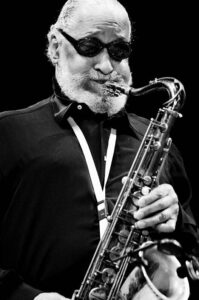
And we know what he looked like old:
We can’t say that about Alexander or Neithhotep – bet she was fine, though.
We know exactly what Rollins talked like.
We can’t say that about Lincoln. We know what he said, and we’re told how he said it, but we’ll never get to hear it for ourselves. (I trust Daniel Day Lewis got close, though).
And we have Rollins’ genius distilled into its most concentrated form. I’m sure Shakespeare would’ve loved for the world to see his plays as they were performed at the Globe Theatre in 1612, but instead we’ll have to read him in a bunch of annotated books.
Hell, even Sousa, whose existence overlapped with recording technology, can’t be heard in an ideal environment, because he personally despised audio recordings, imagining that they would drive him out of business. By the time of his death in 1932, he had only conducted a handful of his marches live on tape.
Whenever we want to experience Rollins’ genius, for however long we wish to experience it. We can fire up Saxophone Colossus, The Bridge, Way Out West, or A Night the Village Vanguard to hear pristine recordings of a master at the top of his game.
Whenever I’m trying to pump up the band for a recording session, I like to remind them that we’re not doing this to commune with the infinite – if no one’s listening to our music now, it’s not goddamned likely that anyone’s going to listen to it when we’re gone – we’re doing this to be the best that we can be in moment. We’re trying to put down a marker. This isn’t the best album of all time, or necessarily the best album that we, as a group of musicians could lay down if given all the time in the world, it’s the best we could do from, say, November 2025 to November 2026.
If you’re someone like Sonny Rollins; someone whose talent peaked when his brand of hard bop overlapped with the public’s taste; someone whose compositions “St. Thomas”, “Oleo”, “Doxy”, and “Airegin” have become jazz standards; someone was once Miles Davis’ favorite saxophonist; that’s pretty damn good indeed.
I’m sure Rollins doesn’t have to worry about his second death for a very long time.