This week let’s do something dumb.*
While the experience of going onto Twitter is akin to wading into a pond filled with radioactive medical waste, occasionally a stupidly engaging bar conversation rises above the sewage and flits across my timeline like a majestic dragonfly.
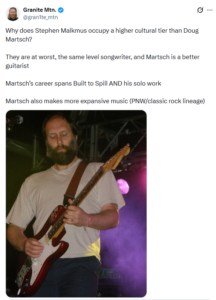
Last week, Granite Mtn. asked the mostly bot-filled void, “Why does Stephen Malkmus occupy a higher cultural tier than Doug Martsch? They are at worst, the same level songwriter, and Martsch is a better guitarist.”
Ignoring the fact that 90% of people probably have no idea who either of these musicians are, I have to admit that the first part of Granite’s supposition feels accurate.
Malkmus and Martsch are both ‘90s slacker rock legends, leftfield guitar gods, and indie lifers, and yet Malkmus seems to have more cultural purchase.
For instance, Marsch’s Wikipedia page is a mere 202 words, whereas Malkmus’s is a sprawling 1108. That’s the difference between a capsule movie review and a New York Times opinion column. Surely the man responsible for the wondrous solo on “Strange” deserves more internet biography than a TV Guide preview of the 2024 Jason Statham action movie The Beekeeper.
Well, maybe. Maybe not.
Let’s get to the bottom of this. Call it Martsch Madness. Who’s our best indie ‘90 hero? Let’s take it section by section.
BEST CAREER: Malkmus released five albums while he was in Pavement (and enough EPs to make a whole shadow catalog), seven with Stephen Malkmus and the Jicks, and two solo solo albums. None of them are bad, at least three are classics, and the rest span from good to great.
As the hub of Built to Spill, Martsch has released nine studio albums, five EPs, and a live album. None of them are bad, at least two are classics, and the rest span from inspired but okay to great. As a solo artist, he released one album, the often acoustic Now You Know.
Both Pavement and Built to Spill, should appear on anyone’s indie Mount Rushmore, but perhaps Pavement deserves the most prominent George Washington spot.
“Doug doesn’t have Slanted and Enchanted,” my buddy Lee said after I told him about the internet discussion, “that’s why he is where he is.”
Pavement’s Slanted and Enchanted did more than any album since R.E.M.’s debut to inspire what we now know as indie rock.
With its brief songs and occasionally atonal guitar, Built to Spill’s first classic, There’s Nothing Wrong With Love, is indebted to S&E as much as any other album. With their next release, 1997’s Perfect from Now On, Built to Spill carved out their lane as a proggy Neil Young and Crazy Horse, but their first big one definitely has Malkmus DNA in it.
Winner: Malkmus.
MOST INFLUENTIAL: Although he always recorded in a studio, Malkmus is the patron saint of any kid who has tried to make an album at home for the cost of a Focusrite interface and an ounce of weed. He proved that you don’t need to sound good as long as you have good ideas.
You can see Pavement’s influence in 2010s artists like Mac DeMarco, Car Seat Headrest, Courtney Barnett, Speedy Ortiz, and Alex G.
Pavement’s reunion shows often draw young attendees. And their Spotify metrics, for whatever that’s worth (to me, almost nothing), outmatch Built to Spill’s by five to one.
Meanwhile, Built to Spill’s influence can be found in Cymbals Eat Guitars, Cloud Nothings, Death Cab for Cutie, and, uh, also Alex G. But I also see it in the popularity of winding, stoned, Tom Petty-esque rockers like The War on Drugs and Kurt Vile. Those fellow travelers may be a little more upbeat than Mr. Martsch, but they’re floating in the same waters.
There’s also an argument to be made that Built to Spill gave permission for indie rockers to spread their wings live, as the genre didn’t embrace jamming until the mid-2000s, when the best way to scratch The Hold Steady, Arcade Fire, and Animal Collective off the bucket list was to catch them at a festival where they could get loose with their arrangements.
You hear less of Martsch’s influence in modern music (and the kids these days certainly aren’t trying to nail his “boomer bends”) than Malkmus’s, but Martsch was fundamental in making rocking out enjoyable again to an irony-poisoned audience – an audience that may have included Mr. Malkmus himself, whose solo career has been as dedicated to reskinning ‘70s rock with an indie patina as Martsch’s.
Winner: Malkmus, but it’s closer than you would think.
BEST MARGINALIA: Martsch’s career is chock full of starter bands, side-projects, and larks. He released three albums with Beat Happening’s Calvin Johnson as The Halo Benders, six (LPs and EPs) with his pre-fame band Treepeople (who in the 2010’s reunited and toured), and various splits with other musicians..
Also one to spread the love around, Malkmus played the sideman on three Silver Jews albums, goofed off on Bob Dylan’s Basement Tapes with Silkworm on The Crust Brothers’ Marquee Mark, and currently plays in the indie supergroup The Hard Quartet, who released their (very good) self-titled debut two years ago.
Amazingly, I like more than half of these records (normally an artist’s marginalia is strictly for diehards only). Each of these guys could have a decent indie career based on the work of their secondary bands alone.
The Silver Jews’ American Bridge is the best of these albums, though. And even though American Bridge has less Malkmus than a Halo Benders’ album has Martsch, I’m gonna give this to Malkmus. Also, I think I enjoy The Hard Quartet better than all of these albums.
BEST GUITAR PLAYING: Granite Mnt. takes it as a given that Martsch is the better guitarist.
Martsch has a magnificent feel, a cherry vibrato, and he plays a wah-wah pedal in a way that doesn’t immediately conjure white boy funk open mic night. He’s a riff machine, but can also spin out an engaging long solo, as he does on Live’s “Cortez the Killer.” Like his primary influences Neil Young and J. Mascis (who he plays and sings like), Martsch is ultimately a boomer classic rock guy. He likes bends, pentatonic licks, and rocking out. But he also likes pedals, distortion, and weird noises. He’s the ‘70s archetype of a guitar god.
Malkmus isn’t. Although he effortlessly played lead while singing in Pavement, Malkmus didn’t become known as a six-string wrangler until into his solo career. On Pig Lib, he proved to the world that he could be a jam god if he so desired, but I don’t think he has ever so desired. That said, Malkmus is a very weird, very original player. He’s a fan of alternative tunings, frequently borrows notes from other keys, and loves to get weird with sounds. In recent years, he has taken to playing the synthesizer, which, you’ll be unsurprised to know, he plays just like his guitar.
In all truth, Martsch and Malkmus are more alike as players than they are different. They both write guitar melodies that are as hooky as their choruses and refrains. They both love saturated, distorted tones. They both have a soft spot for country music, without actually playing like country players. And, when the opportunity arises, both kick out the jams.
Don’t hate me. I’m giving this one to Malkmus in an upset.
BEST LYRICS: Both Malkmus and Martsch have weird relationships to lyrics.
Unlike probably 90% of musicians, Malkmus feels that he has an infinite amount of melodies and a limited number of lyrics. Whereas Martsch told GQ that he doesn’t like writing lyrics at all, and for a while had his (ex-?) wife help pen them.=
You could compile a tao from of Malkmus’s idiosyncratic lyrics. “Is it a crisis or a boring change?” “You can never quarantine the past.” “You’re the kind of girl I like / Because you’re empty and I’m empty.”
And that’s just one song.
One song that somehow makes this chorus work: “Keep my address to myself because it’s secret / ‘Cause it’s secret cret cret cret / Cret cret cret cret cret / Cret cret cret cret cret.” As the first Pavement drummer and producer Gary Young said, “This Malkmus idiot is a complete songwriting genius.”
Martsch on the other hand, nails some concrete imagery (“He thought an Albertson’s stir fry dinner would make his apartment a home”) but too often for my taste fades into stonerisms: “Every thousand years / This metal sphere / Ten times the size of Jupiter / Flies just a few yards past the Earth.” Uh, whut?
Malkmus is a singular, highly original lyricist and Martsch is an often good, but often not, pastiche artist. One of his most memorable songs, “You Were Right” is ruined by verses pinched off of a classic rock station. (The first one quotes Led Zeppelin, Pink Floyd, Jimi Hendrix and…uh, Kansas.)
There’s no shame in losing to this Malkmus idiot in this category, after all he’s a complete songwriting genius.
BEST SINGER:
Martsch knows exactly what his voice can do, and doesn’t try anything he knows it can’t. His high tenor floats above his fat guitar tone like stoned thought bubbles. Even when his music gets dark or hard, Martsch never gets too worked up.
Malkmus had an on-again-off-again relationship with pitch early in his career, so his fans debated whether or not he was even a good singer. That’s silly. Complaining about Malkmus singing in tune, or about his voice cracking is like complaining about Bob Dylan sounding adenoidal. Malkmus’s studied rawness is a feature, not a bug. And that’s because, unlike Martsch, Malkmus always pushes his voice.
He can wring out pathos in a stoned drawl on mid-tempo tunes, but he can also yelp like a pop punk singer. In his recent solo work, he even tries out a falsetto. And the boy can yell.
Winner: Malkmus.
BEST NAME: “Malkmus” has a weird mouthfeel and “Martsch” has a weird spelling. Neither of these are ideal rock & roll names. Let’s call this a tie.
BEST AGE: Malkmus is 59. Martsch is 56. Fifty-nine is more than 56. Winner: Malkmus.
BEST HAIR: For the past 40 years, Malkmus has had the cliche floppy hair and skinny physique of every guitar rock frontman since 1964. Tell a kid to draw a rock star, and they’ll draw you a Malkmus.
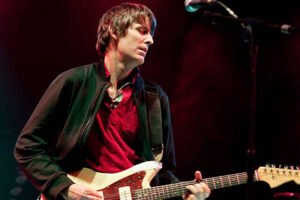
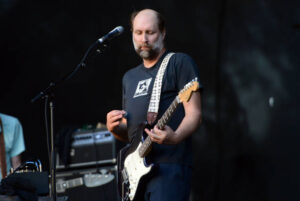
Meanwhile, as Martsch’s hair disappeared on top, it migrated, Woolly Willie-style, to his chin, where it has grown into a righteous mound. Tell a kid to draw a Civil War general, and they might draw you a Martsch. Also, in an era when so many bald white men Bic their heads until they look like 45 caliber bullets, Martsch deserves credit for keeping the sides. Sides rule.
Winner: Martsch.
OVERALL WINNER: The only category that matters on this Martsch Madness showdown is Best Hair, so…winner: Martsch.
I’m as surprised as you are.
* For the record, I can’t be a hack writer because a hack gets paid.