Over the last few months, my buddy Brent and I have been collaborating on new music. Unlike every other project I’ve been a part of, you can’t really classify it as rock. While it contains rock instrumentation (bass, guitar, a guy yelling), the music is mostly composed on the computer using Ableton Live, which allows us more opportunities to throw spaghetti at the wall to see what sticks. Turns out a lot of weird spaghetti sticks.
Although I’m at a bit of a loss at how to classify the music we’re making, the consensus seems to be that it’s industrial. Considering its lyrical themes, pummeling sounds, and frequent harsh noises, that seems fair.
Although I’ve waded around in the industrial waters, I never fully submerged myself…until this week, in which I made a pilgrimage through the first third of the Pitchfork list: “33 Best Industrial Albums of All Time.”
Here are my thoughts, and, on a scale of one to three gears, how likely I’ll be to listen to any given album in the future.
Throbbing Gristle’s 20 Jazz Funk Great (1979)
20 Jazz Funk Greats is the most influential album from the genre’s most influential group, Throbbing Gristle. Hell, its members coined the term “industrial.” Since their inception as part of the performance art group COUM Transmissions, they have lived their art, from Cosey Fanni Tutti’s explorations into pornography and sex work, to Genesis P-Orridge’s body modification, to whatever Peter Christopherson did to earn the nickname “Sleazy.”
That said, 20 Jazz Funk Greats is less a cohesive statement than a greatest hits of sounds and ideas. If industrial music has a progenitor in krautrock (and I think it does), 20 Jazz Funk Greats has more in common with Faust’s IV, than say more, uh, listenable albums like Can’s Tago Mago or Kraftwerk’s Autobahn. The album whiplashes from the Giorgio Morodor-esque S&M funk of “Hot in the Heels of Love” to the major key krautrock uplift of “What a Day” to the, ahem, industrial drone of “Six Six Sixties.”
It’s a classic album (these all are) but not one I’m going to return to often. Two gears.
Einstürzende Neubauten’s Halber Mensch (1985)
I don’t know what Blixa Bargeld and his bandmates are singing about, but I know they are serious. German isn’t a language for frivolity.
After the ear-shredding sheet metal sculptures of their earlier albums, Einstürzende Neubauten forgo electric guitars for the best moments of Halber Mensch. To me, their mechanical dirges recall a steampunk Hundred Years’ War, where chainmail and arquebuses compete with wooden tanks and witchcraft. It’s a potent and peculiar combination. Popped this one into the car radio on the way to work. Weird. Two Gears.
Coil’s Horse Rotorvator (1987)
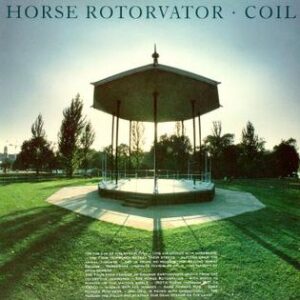
Horse Rotovator pairs pummeling drum samples with twinkling synthesizer butterflies: inspired. Where Einstürzende Neubauten clangs and Ministry slams, Coil prances.
John Balance and “Sleazy” Christopherson (yes, that ”Sleazy”) dial up the bathos for “Ostia (The Death of Pasolini),” give Trent Reznor his whole thing with “Penetralia,” haunt the countryside with “Ravenous,” and write the most unnerving theme song for a goofy ‘60s spy TV show with “Blood from the Air.” Three gears.
Cabaret Voltaire’s Red Mecca (1981)
Out of anything on today’s list, the music of Cabaret Voltaire probably comes closest to my wheelhouse, post-punk. “Sly Doubt,” “Landslide” and “Red Mask” off Red Mecca have the propulsion of their early single “Nag Nag Nag,” but add a depth to the sound. Err, but not too much depth. For while Cabaret Voltaire layer on the organ chords and synthesizer squiggles, the entire album sounds brittle. Vocals get swallowed by their own reverb, guitars struggle beneath the murk, and drum machines rattle about. And yet it all feels intentionally diffuse, like a Cindy Lee record. “A Thousand Ways” is a ten-minute showstopper.
Red Mecca should get a place of honor in the collection of anyone who loves Throbbing Gristle, Pornography-era Cure, Chairs Missing-era Wire, or Bauhaus. Three gears.
Ministry’s The Land of Rape and Honey (1988)
Here’s the first place where Pitchfork and I come into contention. While the Land of Rape and Honey came first, The Mind Is a Terrible Thing to Taste and Psalm 69 sound better and have higher highs (with one exception, see below).
Ministry practically invented industrial metal here with Al Jourgensen’s mutated dill instructor bark, thrash guitars, and ripping synthesizers. BTW, “Stigmata” still tears harder than any industrial song that came before it.
Let’s be real, I’m a rocker at heart and this shit rocks. Three gears.
Front 242’s Front by Front (1988)
Jazzercise for rivetheads. Front 242 burned away the murk, grime, and chaos of earlier industrial, leaving Front by Front’s pristine Terminator exoskeleton. The band’s intricate rhythms, transparent martial vocals, and relentless pace make for an energizing and eventually exhausting listen. As someone who doesn’t need a quadruple espresso to get going, I don’t imagine I’ll be revisiting Front by Front any time soon. Two gears.
Nine Inch Nails’ Pretty Hate Machine (1989)
This is cheating. Trent Reznor may be a renowned producer, composer, and aficionado of industrial music, but he’s primarily a sexyboy rock star. He’s by far the best selling artist on this list and hardly needs the recognition.
Besides, isn’t it a little embarrassing that he sings about “slipping on the tears” that “you made him cry” after “you just taught [him] how to kiss” on a list full of militant queers trying to carve their place into culture?
Yes.
But does Pretty Hate Machine still slap?
Also yes.
Three gears.
Nurse With Wound’s Homotopy to Marie (1982)
Formless experimental music is one of my least favorite genres, and Nurse With Wound make formless experimental music. There are a few good jump scares (that distorted scream nine minutes into “I Am Blind”), and some avant garde ways to play the cymbals, but this is “music” for only the most depraved sickos. Homotopy to Marie will make you feel uneasy and anxious, but so will 90% of the things in life if you dwell on them for too long. This album is the equivalent of thinking you have cancer. One gear.
Killing Joke’s Killing Joke (1980)
This is just post-punk, innit? Is it driving and bass-heavy? Check. Is the guitar slathered in chorus and reverb? Yup. British yelling? Right-o, guv’nor. Monochromatic cover of crowd violence? Kinda hard to tell. (It is.) How is this industrial when Gang of Four is not?
“Wardance” has been making it on my post-punk compilations for years. Is that a bass harmonic? Pretty cool. Three gears.
KMFDM’s Naïve (1990)
This is the type of music I imagine all Eurotrash bad guys from 1990s action movies getting loaded to in debauched discotheques. Would they care for the band’s leftist politics? Probably not, but they would dig the big titty comic book girl on the cover, and would probably recognize themselves in the sinister guy lurching over her.
Speaking of girls, it’s nice to hear a lady singing on the title track. Industrial music can be such a sausage fest.
KMFDM stacks breakbeats, squealing guitars, congos, chants, distorted vocals, and – a first for a German industrial band – humor for their upbeat music. Every track is made for the dance floor, which means there’s not a dead spot on the album, but there’s also not much room to breathe. Also, maybe they should stay away from reggae (cough, “Virus (Dub),” cough). Two gears.
Nitzer Ebb’s That Total Age (1987)
After the sensory overload of Naïve, listening to That Total Age feels like going backwards in time. It’s like cueing up Grandmaster Flash right after Public Enemy.
While Nitzer Ebb’s drum machine/sequencer/shouting jams can’t help but feel skeletal next to KMFDM’s full band blowout, the album gets going for me after the arpeggiator kicks in on “Murderous.” The real club banger is the militant “Join in the Chant.”
(Funny coincidence: KMFDM’s name doesn’t actually stand for “Killing Mother Fucking Depeche Mode,” even though they let music journalists think it does, but it does stand for a non-grammatical German expression (“no majority for the pity”). Meanwhile the British boys of Nitzer Ebb chose their band name because it sounds German, even though it actually means nothing.)
I might just be worn out with industrial music at this point, but if I’m reaching for That Total Age’s type of EBM, I’ll put on Front 242. Two gears, but barely.