It takes a real megalomaniac to list their own record in a column that celebrates Pavement’s Slanted and Enchanted, St. Vincent’s self-titled, and Sly and the Family Stone’s Greatest Hits.
But I’m not here to celebrate greatness. This week’s Heck Record column about Part Time Ghost’s Songs of Death and Love is an exercise in masochism, a bloodletting, a hatchet job. I’m here to drag something out of obscurity, something that’s important to fewer people than the number of fingers I’m using to type this column, and I’m gonna kick the ever-loving shit out of it.
Why?
I don’t know. Probably because instead of writing a column last week, I set my brain on fire watching my cousins get in fights with their friends on Facebook about Charlie Kirk’s assassination (BTW: everyone jumped to “assassination” real quick. Imagine the egg on our faces if the killer was just a jealous lover.)
But instead of writing self-righteous screeds about how I don’t think anyone should get killed by snipers – either in Utah or Gaza – and how maybe we shouldn’t compare Kirk to Martin Luther King, Jr. – because at the very least he wouldn’t like that comparison – I’ve decided to rip myself a new asshole.
Part Time Ghost existed from December 2019, when Nic Conde joined on drums, through September 2022. Before that, the band was an unnamed acoustic duo showcasing the songwriting of Brady Snow and the lead guitar playing of Josh Hamilton.
In 2019, they kindly allowed me to join them, and let me sing some of my own songs, whereupon Brady and I would swap bass duties. We tried out a series of drummers, but the pieces didn’t fall into place until we added Nic, who was head and shoulders above every other drummer we tried.
After a couple of weeks of woodshedding, we played our first show together, the day before Valentine’s Day, at the Lion’s Lair. We didn’t play live again for nearly a year – and only then under the specter of COVID. Police tape blocked off the dance floor at Herman’s Hideaway to keep the masked audience from getting too close to the band or each other.
But in the intervening year, we met twice a week, worked up at least two dozen songs (I’ve a recording of a marathon practice in which we banged through over three hours of original material), and recorded an album, Songs of Death and Love.
Although that era was suffused with dread, I remember it somewhat fondly because we had each other. And we were making strides. Nic taught himself how to record music. I (finally) taught myself more than just the rudiments of music theory and was cranking out material. And Brady and Josh were expanding the band’s sound into a colorful, multi-genre mélange.
Every week we worked on my favorite part of making music: breaking in new songs. It’s still magical to me taking a tinny demo and blowing it up to a be visceral, muscular, and three-dimensional. It must be how the Amish feel when they raise a barn.
In any normal situation, we would’ve put the songs through their paces live. Because of COVID restrictions, that was out of the question, so we jumped straight to recording.
Although most of us had studio experience, none of us had completed the recording process from scratch. Thanks to YouTube, extra spare time, and perhaps the existential urge to create something more lasting that a night of memories, we set about recording our debut album.
They say making your first million is the hardest. That proved to be the case for our first album as well.
It was all very slapdash. A folding table for a mixing desk, XLR cables slung in eight different directions, an SM58 that looked like it had been a dog toy…but it was fun enough that we all showed up to the recording sessions, even if we weren’t playing.
We literally dragged mattresses down two flights of stairs to the basement of Brady’s house and used them to build isolation chambers for the drums and amplifiers.
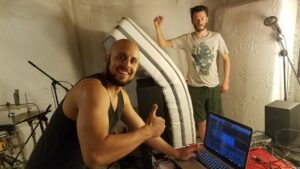
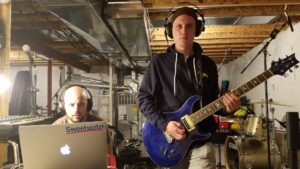
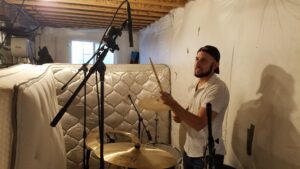
Oh, yeah…amps. We recorded this thing by pushing electrons through transformers and vacuum tubes. In the past decade, digital signal processing quality has improved enough to rival mechanical sound — while also being leagues easier to work with — but we hadn’t yet taken that step.
But enough preamble, let’s bust this labor of love into little pieces.
Songs of Death and Love? Seriously? That’s the title? Oops. It was supposed to be a joke, and I don’t think it translates. English teachers tell students to avoid writing about death and love lest they get stuck grading dozens of short stories of the most self-serious, awful, cliched drivel. How would you like an album of that?
When you’ve spent a year engulfed in an endeavor, you get bored with what you used to love, and you start making “creative” or “clever” choices to mix things up, hence the title. The album should’ve been titled Part Time Ghost.
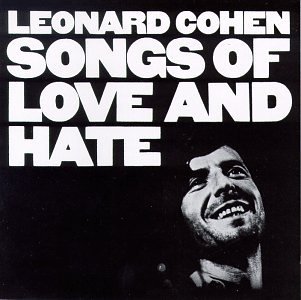
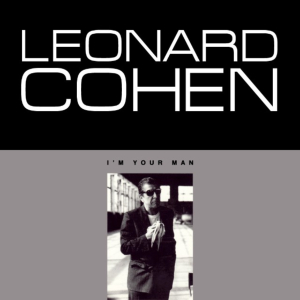
Besides, the it also alludes to a Leonard Cohen album, and you shouldn’t do that unless you mean it 100% genuinely or 100% ironically, and this album doesn’t mean 100% anything.
Also, I think Nic asked to flip “Death” and “Love” so that “Death” comes first, which really doesn’t make any sense even though it does sound more hardcore.
From here, let’s go track by track.
Putting “Three in the Chamber” as the opener was my bad. While sequencing, I learned we hadn’t actually recorded a cohesive batch of songs. I imagine a record exec chiding us: “I don’t hear a single.”
A more fitting opener would’ve been the next track “Can of Worms,” but that couldn’t be the next track because…well, I’ll explain in a minute.
“Three in the Chamber”’s drum solo would’ve made more sense for a change-up on the album’s back side than as the first thing you hear. I think it’s a cool way to intro a song, but not an album.
Besides, once the song actually kicks in, it doesn’t hit as hard as it should. For some reason we decided to hold the lead guitar until the second verse, which makes my voice sound awful alone by itself atop my rhythm guitar.
You have two seconds to grab a listener nowadays, and I feel I wasted the opportunity to blow some hair back by slow-rolling it.
But here’s the real problem: about that singing…sorry.
It was the best I could do at the time. Nic and I later learned that in order to get people who didn’t just look at our hands while we played to come to our shows, we would need a singer who had more than an eight note range. More than any song on the album, I think “Three in the Chamber” showcases my deficiencies. I remember that chorus taking a dozen tries to get right, which is probably why it sounds so stilted.
That said, even though I don’t like my performance, I like the song. It has a pre-chorus (which was rare for us) and an evolving bridge progression that allows Josh’s solo to really boil over. If the whole song sounded as good as it does in the last chorus, I would have no issues with it at all.
I think we only played “Three in the Chamber” once or twice live, mostly because that riff had me jumping all over the neck, which was hard to do while singing. (Another benefit to having a designated singer in your band? You can make the guitar or singing as wild as you want without splitting your brain in half to do both at the same time.)
The real opener should’ve been a Brady song, either, “Diffused Shine” or “Can of Worms.” But by the time we released the album, I had killed Brady, and we didn’t want to open our debut album with a dead man’s song. I’ll explain.
Although recording Songs of Death and Love wrapped in the fall of 2020, we didn’t release the album until nearly a year later, at which point Brady had been replaced by singer/bassist Robert Keiton Smith, we had moved our studio from Brady’s basement to Nic’s basement, and I had Brady’s blood all over my hands.
On a crisp spring day in 2021, I broke COVID-distancing protocol to hug Brady and drop the hammer: “I love you but I don’t want to be in a band with you any more.” Fuck, man. He walked back upstairs after five minutes of awkward chatting. One of my best friends…knife in the kidney.
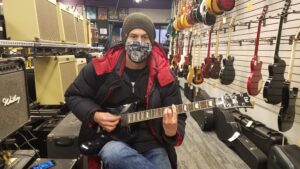
Even at the height of COVID, Brady had a busy work-, play-, and love-life, and it felt, to some in the band (that passive phrase), that he wasn’t prioritizing us.
About three months later, while carousing down south Broadway, Josh (who rarely drinks) drunkenly called out Nic and me for pushing Brady out. He was right to. We’d killed the band the two of them had created.
I contend that Part Time Ghost would’ve fallen apart over the next couple months without an intervention, and that kicking out Brady was a prophylactic measure. But narratively, it also looks like Brady invited me to join his band and I snaked it from him. They’re both true.
Brady and I didn’t talk again regularly for at least a year.
As evidenced in the whiplash from track one to track two, Brady and I never really incorporated each other into our songs. He would sing; I would play bass. I would sing; he would play bass. Musically, the band’s only points of continuity were Nic’s drumming and Josh’s liquid lead. Every time we changed singers, we might as well have been changing bands.
Brady has an open heart. He sees the beauty in nature, space, and humankind. He wants to eat the world and feel the juice run down his neck. Three of his songs here reference drinking wine, the most bacchanalian of drinks.
Although he typically wrote in minor keys, on Songs of Love and Death, he doesn’t play them like minors, preferring power chord riffs that give his songs a sense of uplift. The album’s weirdest track, his “No Milk, No Wine,” is technically in Locrian mode, the gnarliest mode, but he stabilizes it by treating the tonic – which should be a flatted fifth! – as a typical E power chord. Don’t get me wrong, it’s still the wildest song on the album, but it’s not as tooth-grindingly abrasive as it theoretically should be. In fact, it’s almost celebratory.
In contrast, I have a closed heart and a darker worldview. I believe that much of life is toil and/or suffering, that transcendence is rare, and that contentment should be protected. I also don’t think dogs actually love you. I think they love the food you give them. (Nah, I’m overselling that. The bestest boys love us deeply.)
Three of my five songs here end in death. In “Three in the Chamber,” it’s a spousal double murder. In “Now We’re Family,” it’s a Waco-style shootout. “Empire Falls” ends with the whole system collapsing.
Like Brady’s, my rhythm playing at the time typically involved barre and power chords, but also 7th and 9th chords, always played slightly overdriven. Brady called it “grunge jazz.”
Brady’s “Can of Worms,” the album’s shortest track at under two and half minutes, is a perfect example of why computers will never replace art. While AI can get hallucinatorily weird, it doesn’t do it intentionally.
For Brady, on the other hand, I think that’s the point. He used his grey matter to turn the idiom “can of worms” into a song about broken hearts being repaired, the nature of the souls, and a dig at commercial artificiality. He also hits every power chord in the key in a bizarre, almost avant-garde bridge which includes the head-scratching couplet: “Place the body where the heart is / Breathe into the space behind the heart.” I should ask him what it means.
The bridge ends: “Love don’t break hearts / They keep on thumpin’.” Brady could write unusual lines, filled with offbeat imagery, but then hammer home a universal truism. AI could never.

I wrote “Italian Meal” literally fifteen years before we recorded it and mostly disliked it. Then I overhauled the last verse, added a bridge, and, somehow, it turned into a song people liked.
“I ate an Italian meal that looked like a car crash victim.” If you can land the first line, most people will follow you all the way to the end.
I like what we tried to do with “Italian Meal.” It features some actual arraignment, beginning with the only fingerpicked acoustic on the album (which sounds a little thin, but whatever) and builds to a full final chorus with all the “ghost” back up singers. We could’ve used some organ at the end.
Although I like writing melancholic folk songs, I can’t sing them. My voice, which I’ve come to appreciate, does two things well: barky garage rock, and creepy monotone sing-speak (generally under a lead singer). Honestly, “Italian Meal” would’ve sounded much better sung by Keiton (who has a charming Southern lilt), Josh (who had the best voice in the band), or…goddamn it, Brady, whose voice sounds richer than mine on this whole album, even though he could be just as wildly off-key while singing live.
Going forward, the Ghosts stopped writing folk-style songs, although we kept playing this one live right to the end. You could even call it one of our “greatest hits.”
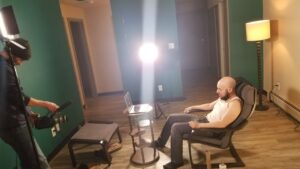
Brady directed the music video for “Italian Meal,” which starred Nic as the song’s depressed protagonist. Nic pukes Ragu into a toilet and ends up face-down, naked ass up during the song’s solo, before pulling things together enough to play drums with the rest of the band at the song’s end. It’s my favorite of our videos. Nic’s a natural actor and he has a nice butt.
https://www.youtube.com/watch?v=2MIZsmBKg3Y
“Diffused Shine” is hippie-dippy bullshit about Brady going on a hike. JK. (It’s not bullshit, but it is hippy-dippy as fuck.) This one was always fun to play live.
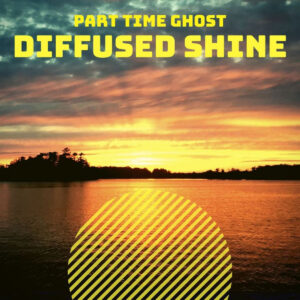
I remember getting a blister on my finger playing bass slides over and over for the recording, and Josh nailing that magnificent solo on his first try, insisting he needed a do-over, and all of us practically holding him down to keep it as is. Whatever he disliked about the solo, I don’t hear it. It’s got mojo.
If there’s an undersung member of Part Time Ghost, it’s our lead guitarist.
Josh can find a melody in anything, writes around often complex rhythm guitar, and has a magnificent sense of dynamics. He’s the only lead guitarist whose volume I never wanted to turn down. And, when he needs to – as he often had to in Part Time Ghost – he can shred.
He turned me around completely on two effects that I had no use for before I met him, wah and octave. Now, if I’m playing a lead line, you better believe I’m either topping it off with an octave up or smearing it with some squiggly EQ business.
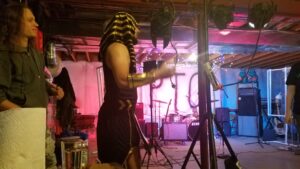
Look, Part Time Ghost never became anything more than a local Denver band, but we were a good local band, and that’s almost entirely due to the musicianship of Josh Hamilton and Nic Conde.
Oh, also, Josh’s harmony vocals on the chorus of “Diffused Shine” are the best on the album.
After the fiasco of shooting the music video for “Empire Falls” (more about that in a minute), the gang weren’t too excited about recording another one, but Brady insisted we didn’t have to work too hard. The PTG part came together during a work night. A week later he uploaded the official “Diffused Shine” music video. Of course the meat of it was ten years of photographs from Brady’s adventures in the wilderness. That was what he was leaving us in Denver for every week.
https://www.youtube.com/watch?v=vy5uNde-k14
“Empire Falls” was our first recording, our first music video, and, I think, the last song written for the album. Inspired by the 2020 decline of…well, everything, I wrote and demoed a three minute punk rock song in literally two hours, but I didn’t think it was over with after the last verse, so I just kept playing for two more minutes. The punk turned funk.
It took me the entire run of the band to realize that Part Time Ghost weren’t actually a garage rock band, we were a jam band (At the time, I hedged, calling us “psychedelic,” even though anything psychedelic vanished after Brady’s departure). Because of the variety we would throw at an audience and the typically gnarly subject matter of our lyrics, one fellow musician called us “evil Phish.” (I dunno, I think evil Phish is Ween.) At our best, we were a dance band that played garage rock, and “Empire Falls” merged those two parts together.
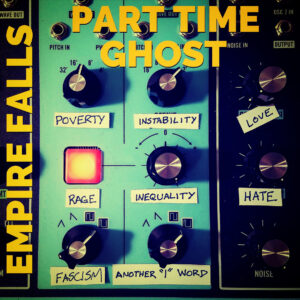
I still really like “Empire Falls,” even though it bothers me that in going wide with the vocals, the volume seemingly dips during the chorus, and I wish I had the wherewithal to chop off the final chorus. The song climaxes and then goes on for thirty more seconds. It should be five minutes flat. That’s the stuff that happens when you record your material too quickly.
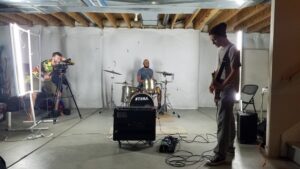
In the summer of 2020, we shot the music video for “Empire Falls,” a twelve hour ordeal. Brady’s stage lights kept tripping the breaker box, so we had to buy extension cords to balance their power draw throughout his entire house. Once the filming commenced, though, we had a jolly good time – as evidenced in the extremely goofy video.
Once again, I’ll single myself out for opprobrium. 1.) I couldn’t mime my own vocals for shit and 2.) I should’ve never shaved for the shoot. I’m like Viggo Mortensen (yeah, right): these cheeks should not be shorn.
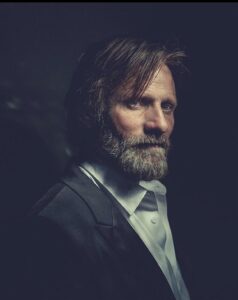
Two years after we released it, one of Nic’s roommates, a bubbly 21-year-old, pointed at me in the video and asked, “Who’s that?” I was sitting next to her.
That first shot of Josh tripping still kills me.
https://www.youtube.com/watch?v=IUBia7AZzWg
I keep waiting for “Empire Falls,” which was written at such a specific moment in time, to go out of date, but it’s five years later and we’re still here: “Dow Jones crashes just like an airplane / Built by Boeing, and we’re all screwed.” Who has got that again on next year’s Atrocity Bingo?
“Liberal/Racist” is the other “greatest hit” from Songs of Death and Love, the only other track we regularly played live.
I wrote it in my dissolute twenties about a woman I was spending time with. (Although I’ve always argued I write “in character,” most of those characters have more than a little grounding in personal experience.) She had some good opinions about gay marriage, and some bad opinions about Mexicans. She was also pretty fun when she got drunk.
When Brady said I wrote “grunge jazz,” “Liberal/Racist” is what he was talking about. Hell, it even takes the most cliche progression in jazz (the ii-V-I) as the starting point – not that I knew that at the time.
I actually don’t hate my performance on this one, but I’m aided immensely by my fellow Ghosts, all of whom sang backup, and, especially, the musician Jeannie Marie, Nic’s then-girlfriend, who was the band’s secret weapon. Her voice always felt like a very expensive effect.
Structurally, “Liberal/Racist” is the simplest song on the album. It’s literally a verse and chorus repeated three times. But Nic makes it so much richer by varying his drums each time out.
Like “Italian Meal,” “Now We’re Family” began as a long lost cast-off, got reupholstered, and made it onto the album. Unlike “Italian Meal,” it’s a weird one. The verse’s stairstep riff includes every chord in the key except D major, and the chorus chucks out key altogether. We played it live with a Picardy third, which gave it an exultant-sounding ending. I wish we recorded it that way.
“Milk, Wine, Bone, Blood” followed “No Milk, No Wine” when we played live, but I thought it best to end the album with a bang – and give listeners a chance to bail if they didn’t want to listen to nearly five minutes of chaotic noise. (The same holds true of the Heck Reckoners’ debut. If you want to bail, click off midway through “Winter’s Gone.”)
On the prettiest song on the album “MWBB,” Brady touches the infinite with awe and gratitude: “The solar system’s the place to be / The Milky Way’s my galaxy.”
Man, we’re so different.
When I think of space, I think of darkness and freezing death. It’s the opposite of home.
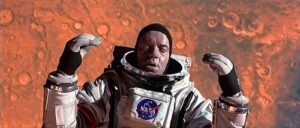
“MWBB” did, however, give me the opportunity to play some very remedial organ. During the COVID lockdown, I spent some time learning how a piano works, and was more than happy that my key mashing made it on the album. I even proudly attributed “Keys” to my list of “instruments played” on the album’s Bandcamp page. I played those keys with just about the same precision as a cat walking across them.
The individual recording tracks on our closer, “No Milk, No Wine,” must’ve run into the dozens. Around Brady’s cycling rhythm guitar, my bass, and Nic’s drums, Josh overlaid multiple lead lines, I added a mess of Moog synthesizer, and all of us contributed back-up vocals, from my ominous monotone, to Brady’s wacky cartoon goofs.
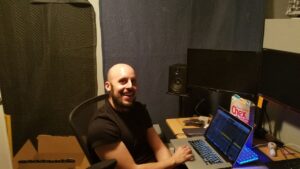
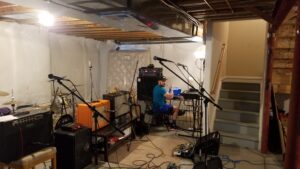
If the album has an MVP, it’s Nic Conde, who, I need to reiterate, taught himself how to record music over the pandemic lockdown, and used his new skills to record our dumb band. You have to tell most drummers not to drink out of the toilet, and here was ours, producing, engineering, and mixing our debut album. That’s King Shit of Fuck Island, my friends.
I’m sure “No Milk, No Wine” was a motherfucker and a half to mix, but all of its roiling nonsense makes sense because of the mix. Don’t think that I didn’t notice: when Nic wants to play someone a song from the album, he always puts this one on. I bet it took hours and hours to get right.
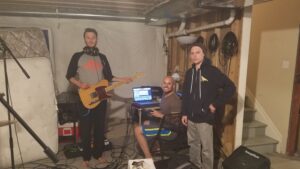
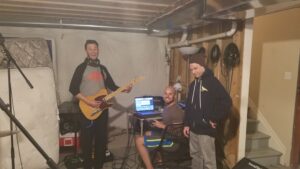
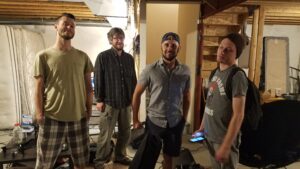
Despite my frustrations with the shortcomings of the album (99.7% of which I’m exclusively responsible for), I believe it’s a good record with good songwriting, unusual musical choices, and some excellent playing. For what it’s worth, I also think it’s pretty funny. And it rocks.
I also don’t think it really got much of a shot to find an audience because the band who made it had already dissolved by the time we released it. Songs of Death and Love captured the zenith of Part Time Ghost Version 1.0, but once it came out, PTG 2.0 was already in full swing and we didn’t give it the attention it deserved. (I went through the band’s Facebook page while writing this article, and was shocked to discover that we didn’t even post about it. What the fuck is that?)
Look, I understand that most artists toil in obscurity, and that for every worthy artist who gets recognition, a dozen slip away unheralded…and those bands have good singers. But I wanted to draw some attention to an album whose flaws still (mildly) torture me, because we made it.
And we love each other.
If you wanna throw us some bones, you can buy Songs of Death and Love on Bandcamp.