She introduced me to her friend. “This is Zac. He’s really funny.”
“Oh, yeah,” the guy said, sizing me up, probably rightfully concluding we were chasing the same girl. “Make me laugh.”
Ugh, gauntlet thrown. After giving him the side eye, I chuckled. “Fuck that, man. Make me come.”
He laughed. Mission accomplished.
Well…I won the battle, but I think he won the war. I sure wasn’t the one who took the girl home that night.
—
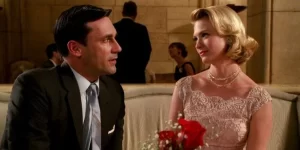
A different girl held the microphone while I played a song with satirical lyrics about building a relationship with the dynamics of Don and Betty from Mad Men (this was before the fuckless retvrn morons made a political project of it, and, ironically, before Mad Men). “That’s the way these things are gonna be / We’re gonna live like the 1950s.”
She told me afterwards. “I really like those parody songs you do.”
Parody? Ouch. I wanted to write a good song, a rock song. Didn’t you see how I dropped a beat during the chorus so it feels off-kilter? Didn’t you like that augmented chord? No other song sounds like this. I write lyrics and music, doll.
Every artist wants to be recognized for what they’re second-best at.
—
I like to make people laugh. Who doesn’t? And I like to think that, given the right set of circumstances, I’m pretty good at it.
I got started performing in front of crowds by reading short fiction at open mics in coffee shops and bars. In that environment, the best way to get and keep an audience’s attention was to ensure that they were laughing. At the same time their laughter let me know that they were paying attention to me. It’s a feedback loop. I’ll give you the giggles and you give them back.
Occasionally, someone would drop a heart-wrenching bomb and the room would fill with tension. I’ll remember until the day I die when a middle-aged man told the crowd about how a coach raped him and his friends in middle school and then blackmailed them about it. The coach was long dead, but the intensity of the man’s rage and shame filtered through the audience like an airborne illness, until everyone felt like sobbing. He turned that awful experience into a devastating piece of art.
Thankfully I didn’t need to follow him.
As far as creating an emotional moment, that’s a high-risk, high-reward gambit.
I also remember when a reedy young woman cracked open The Bell Jar and tried to traumatize the audience with Sylvia Plath. They weren’t having it. As the speaker continued reading about the author’s descent into the depression that would ultimately take her life shortly after the book’s publication, the audience zoned out. At first they sat in polite silence, but by the end, they were chatting softly among themselves. There was a lull between when the speaker had finished reading and the audience’s scattered applause. Brutal.
I could never get in front of a crowd and discuss rape (which I’ve thankfully avoided thus far) or depression (which I’ve thankfully got under control) without a hearty side of humor. Like a lot of my millennial cohort, I have a hard time with earnestness, and probably at least second-degree irony poisoning.
The world, which seems especially awful right now, seems more bearable when you can make jokes about Netanyahu being the US president or how Jeffery Epstein wouldn’t invite the richest man in the world to be blackmailed at his child-rape island because he was such a lousy hang with no chill at all.
Besides touchstones like The Simpsons, Seinfeld, and South Park, my sense of humor was shaped by authors like Kurt Vonnegut and Joseph Heller, creative absurdists whose novels are nonetheless as sad as they are funny.
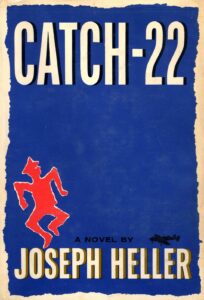
Heller made WWII aerial bombing seem like both summer camp and hell in Catch-22. On one hand, the jokes made the horrors of war palatable. But, on the other, its moments of darkness felt rawer when contrasted with the rest of its charming levity. You can stomach Milo Minderbinder bombing his own troops in the name of capitalism or Snowden’s stewed tomatoes spilling across the deck of a B-25 because of the novel’s comic irrationality.
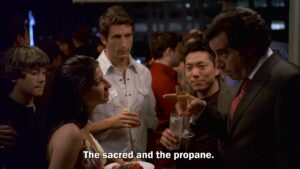
As someone who typically writes about “heavy” subject matter, I like that juxtaposition between the sacred and the profane, between chuckles and sobs. Ultimately, I don’t know how you get through life without laughing at the absurdity of evil or the incongruence between being good and being powerful.
In recent years I’ve worried that I use humor as an artistic crutch. But I think it’s worse than that. I think I use it as an emotional crutch. But instead of trying to live without my crutch, I think I have to accept that I’m handicapped and need a crutch.
—
This week’s record was made by two men who never worried whether their humor was hurting their music, Jack Black and Kyle Gass.
Tenacious D’s self-titled album is a greatest hits of all the wonderfully stupid, funny, rocking songs that JB and KG debuted at LA open mics, improv shows, Tool concerts, Mr. Show, and on their own HBO series over the decade leading up to its 2001 release.
It features the then superhot Dust Brothers behind the mixing console, Dave Grohl on drums, and a bunch of ringers on everything else. However, the star of the show is its two portly front men, their acoustic guitars, their love of metal, weed, food, and sex, and their desire to “rock your fucking socks off” and “screw you gently.”
The only part of Tenacious D that doesn’t hold up is something that plagued albums (mostly rap albums) throughout the 1990s: the skits. “Cock Pushups” and “Drive-Thru” were memes before memes, but they’re jokes. And jokes are not as replayable as songs. It’s one instance where going for the humor hurts the music.
But if you keep to the music, you’ll have a rocking good time and you’ll laugh a lot, too.

Comments