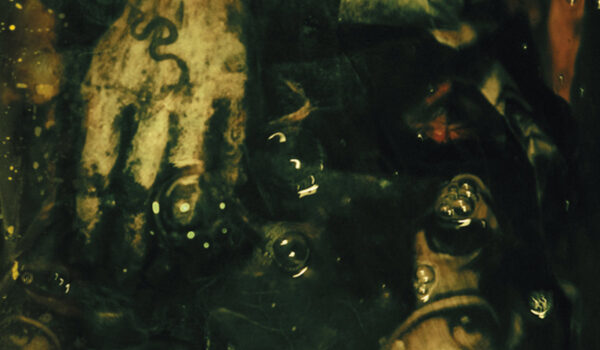
The Mekons were not a country band before they released Fear and Whiskey in 1985. Hell, they were barely a band at all, having gone on hiatus after an initial run of albums at the end of the 1970s. In those early days, when they sprang from the same University of Leeds scene that gave us Gang of Four and Delta 5, they were less a band than a collective, and less musicians than noisemakers. Their debut, 1979’s The Quality of Mercy is Not Strnen, differentiates itself from the political dance music of their punk peers by being slightly less catchy – though it does have a (short) drum solo! It is not, in the least, a country album, and they were not, in the least, a country band.
Then, just like that, they became one. Tom Greenhalgh, one of the band’s creative drivers, said he spent a lot of time listening to country music in the early 1980s, and that “the difference between the three chords of country and the three chords of punk became blurred.” That’s how it happens. You add some Hank Williams and Johnny Cash to a listening diet of the Sex Pistols and the Clash, and then soon you’re wondering how your music sounds with sawing violins, accordions, and high and lonesome vocals.
I’m not typically a fan of country music…which is wild because country songwriting does three things I respect and adore.
1.) They make killer singalong choruses. From “Friends in Low Places” to “Man! I Feel Like a Woman” to “Family Tradition,” country has an overflowing catalogue of lines to shout out into the sky while driving a convertible or into your friends’ faces while getting smashed at a bar.
2.) “The stories man, listen to the stories,” so said Charlie Parker when asked how he “could stand that stuff.” I came to songwriting from narrative fiction, so it always made sense to populate songs with characters and plot. Country music does this as well as folk or rap, and often more concisely. In “A Boy Named Sue,” a father gives his son a soft name so that the son’ll grow up hard enough to kill his father. That’s a Greek tragedy in two dozen lines.
3.) They could be devastatingly sad or funny as hell. We learn the man in “He Stopped Loving Her Today” stopped loving her, not because he forgot her, but because he died. Or we meet a man who can’t afford to take out his woman because there’s “Too Much Month at the End of the Money.” Sometimes a song is both funny and sad. Robbie Fulks’ “She Took a Lot of Pills and Died,” about an aging starlet dying in squalor, is somehow both heartbreaking and rollicking.
I also love how country music can be the best delivery mechanism for a keening glissando, whether from a pedal steel guitar or the human voice. American country music is surprisingly popular in countries that don’t speak English, and I think it’s because listeners identify with that mournful, quavering sound. For whatever reason, people can sound mighty purdy when they’re sad.
But it’s in country’s pursuit of sounding “purdy” when the music loses me.
Too often country music overdoses on purdy, whether by adding extra honey to the vocals, an unnecessary string section, or cleaning up the instrumentation so it offers maximum punch on the radio during the evening drive time. Country is a tradition-bound music, averse to rapid change, with powerful industry gatekeepers in Nashville, Kentucky – “Music City” – that seemingly exist to ensure that nothing too progressive, ugly, or weird gets too popular. Understandably, my favorite “straight” country albums tend to be live – e.g. Johnny Cash’s At San Quentin, Willie Nelson’s Complete Atlantic Sessions – where the Establishment can’t get in trouble prettying them up too much.
…Which brings us to today’s album, the Mekons’ Fear and Whiskey. It’s not a live album, but it has the shambling energy of one. It also has the self-righteousness of a political punk album, and the experimentation of an art rock record. It’s certainly the only country album that’s influenced as much by Hank Williams as by the Velvet Underground.
With “Chivalry,” the record begins normally enough. Sure the singing is a little weird. You don’t typically hear country-style music delivered in that accent – North England – but the song, about a regrettable, drunken encounter in a bar is Country 101. And then come the yodels. It’s the most iconic part of the song, and any Nashville producer worth their bonafides would’ve cut them completely because they are wayyy out of tune. But the Mekons don’t need their doot-doot-doots to be in tune. They don’t need them to be pretty. They just need to be effective. And they are. In fact, because they’re not in perfect tune, they’re even better at putting us in our singer’s ashamed headspace.
Things get weirder from there. “Trouble Down South,” despite its shuffle beat, violin, and angelic backup vocals isn’t country so much as an experimentally narrative. The next song, “Hard to be Human Again,” has the lyrics of a Hank Williams song, but the thrashing, processed guitar of British punk rock. “Darkness and Doubt,” as so many country and folk songs have in the past, details labor unrest – the Mekons actually re-formed as a band to support miners during the 1984 UK Miners Strike. The weirdness peaks with the spoken word nightmare “Psycho Cupid (Dancebird on the Edge of Time),” in which a woman describes a violent incident, a monotone witness report. It’s like nothing you would find on Rascal Flatts record.
After the whiplash of the first half, Fear and Whiskey settles into a more traditional country punk record in the second half. “Country” is a yearning country rocker, “Abernant 1984/1985” is revved-up British folk music, and “Lost Dance” is a song of love and loss. How country! The record wraps up with a song Hand Williams popularized, Leon Payne’s “Lost Highway.”
The Mekons consider themselves the longest-running band from punk’s rock’s first graduating class. They’re still going nearly fifty years after they first met. But Fear and Whiskey is their most important record, and it set the tone for their career going forward. This type of music is their stock and trade: punked-up roots rock, and, yes, ugly country.