This week’s Heck Record was a special request by Kylee. If you want to recommend an album for the Heck Record of the week, put it in the comments.
Indulge me, please. I made a D&D Character Alignment Chart for Friendly and Weird.
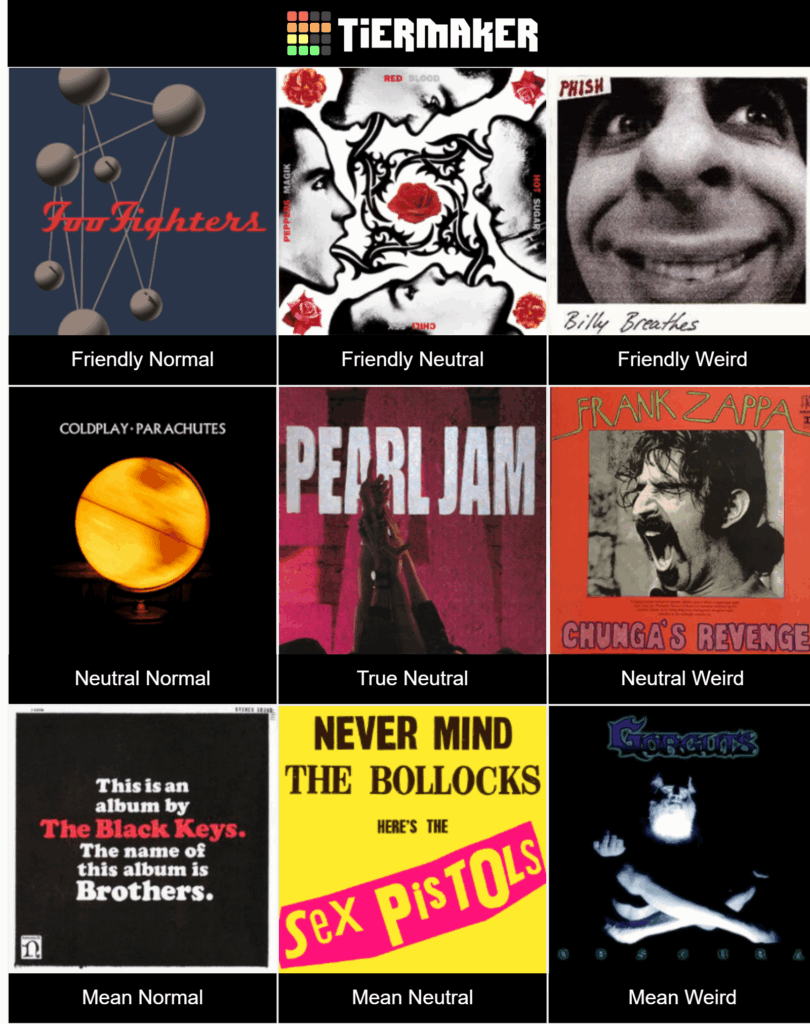
What makes a band friendly? You might think that it’s whether or not the band members are chill, but that’s not really what I’m talking about, at least not entirely. Chuck Berry was famously a brutal taskmaster, who also allegedly took photos of unsuspecting women on the toilet, neither of which is friendly behavior. However his music is joyous, upbeat, and charming. You could play it for children and the elderly and it would make them both smile. After all, he sang about “Johnny B. Goode,” not “Johnny B. Bad.” Pretty friendly.
By contrast, the music of Anal Cunt is…not for grandma and baby (or, really, anybody). But I’ve read accounts that say the band members were super cool guys who were very appreciative that they could make a living playing and writing songs like “I Became a Counselor So I Could Tell Rape Victims They Asked for It.” The metonymic AxCx are definitely not a “friendly” band.
As you might suspect, whether a band is friendly or not is a vibes thing. If you refer to the “Friendly” section of the chart you’ll see bands like the Foo Fighters, Red Hot Chili Peppers, and Phish. The Foo Fighters are a bastion of rock positivity because Dave Grohl is essentially a Labrador retriever. His persona makes the band friendly, even when their songs – and the band’s history – have gotten dark. Similarly, the Red Hot Chili Peppers have taken the mantle as a “friendly” rock band as its members have matured. Quite frankly, their appreciation for being alive and still playing together is something other bands should find inspirational. They also seem to give a shit about womens pleasure in their many, many fuck songs. Phish, another band with dark patches in their history, are “friendly” by dint of the inclusion of their fanbase. Phish fans exist seemingly to create more Phish fans. This is a band that seemingly revels in bringing people together and making them feel good. (That’s also what the drugs are for.)
Conversely, many bands have no desire to be friendly. Some want to be as repellant as possible. Metal musicians, like Gorguts, intentionally play dissonantly and dress off-puttingly as a way to actively cull their fanbases. Likewise, punk music like the Sex Pistols is fueled by aggression – sometimes righteous, sometimes anarchic – that ensures it’ll never find its way on “good times” playlists. And some bands, like The Black Keys just seem like they are jerks, and that they make music for other jerks. I can’t quantify this, but, to me, it feels right, which ultimately is what matters when it comes to determining whether a band is “friendly” or not: does it feel like they are.
By any metric, They Might Be Giants are a friendly band. They’re headed by the two Johns, Flansburgh and Linnell, who’re lifelong friends and creative partners. Both men have been married forever, and regularly play with the same musicians. At various points in their career they’ve literally created children’s music. All this personal stability girds their professional career, which has only seemed to hit rough patches when they cranked up the guitars too loudly or when their record label didn’t know what to do with them. There don’t seem to be any skeletons in these closets.
As far as their music goes, it’s welcoming, mostly major key, rarely saturated with distortion, rarely dissonant, and often silly. But is it weird?
This week’s Heck Record is They Might Be Giants’ second, 1988’s Lincoln. And today we ask: what makes a band weird?
It would be easy enough to default to Justice Potter Stewart’s definition of obscenity – “I know it when I see it.” – when determining “weird,” but I actually think it’s more quantifiable than “friendly.”
In fact, I think you can make a checklist:
- Weird bands use non-rock instruments in a rock context, especially accordion, marimba, timpani, woodwinds (other than sax), horns (other than trumpet), xylophone, etc: Certain timbres don’t fit naturally alongside snare drums and distorted guitars, and weird bands revel in the juxtaposition. My guess is that a guy who puts a French horn in a rock song probably likes pineapple on his pizza.
- Weird bands love chromaticism: The blues loves going one note at a time up a 12-note scale. But when divorced from the blues, playing all the notes together sounds wonky. Weird bands make music that sounds like Julius Fucik’s “Entry of the Gladiators.”
- Weird bands use non-traditional song structures: listeners have like a hundred years of expectations on how a rock song should unfold: intro, verse, pre-chorus, chorus, bridge, outro. Most bands scramble around the pieces a little bit, but put them back together in recognizable forms. Weird bands, however, might not. Orthrelm’s OV is the same riff for 45 minutes. Suck shit, structure.
- Speaking of which, weird bands have different clocks than other bands: Anal Cunt jammed 39 tracks on their 32 minute album It Just Gets Worse. Shellac made listeners trudge through through “Didn’t We Deserve a Look at You the Way You Really Are,” a rhythm section exercise that goes for over 12 minutes – 11 minutes and 30 seconds longer than necessary.
- Speaking of pissing people off, weird bands often don’t give a shit if they make music their listeners want to hear: The Beatles famously tested their fan’s patience with the “White Album”’s “Revolution #9,” a nine-minute musique concrète mindfuck that probably sounded a lot better with a head full of acid, but that track was on the easily skippable final side of a double album. The same can’t be said for Lou Reed Metal Machine Music, a double disc of literal static, that baffled and irritated fans and critics alike (especially coming, as it did, after the commercially aspirant Sally Can’t Dance). Reed alternatively referred to MMM as either a joke or a serious artistic statement. Like a lot of things about Reed, history was on his side, and the album is now considered a progenitor of a genre of unlistenable music called harsh noise. He may be the most influential musician on normal and weird musicians alike.
- Speaking of Reed, like a lot of weird musicians, he had a non-traditional singing voice: Look at your Davids, Byrne, Thomas, and Bowie. Each sang weird. Each was weird.
- Weird bands hopscotch genres: Sure, most rock bands will try out a ballad or country tune, something in an adjoining genre, if they feel they can get away with it. Hell, if you can play it, why not play it? But a weird band will try something way out of their comfort zone. Bossa nova? A torch song? Vaporwave? Weird bands have not only big ears, but an adventurous appetite. Why just listen to Nintendcore when you can record Nintendocore?
- Weird bands are goofy. Here’s where I’ll come back to Stewart’s definition. I don’t know how to describe “goofy”, but I know it when I see it. And I admit to having a bit of an allergy to “goofy.” To me, the word has a pejorative connotation because it’s the antithesis of cool – which is odd because there’s such a fine line between goofy and cool. When the B-52s don wigs and thrift shop cocktail dresses, I think it’s cool. When Phish does it, it’s goofy. I get it, though; I’m probably prejudiced.
So how do They Might Be Giants do with the Weird Checklist? Let’s see….
- Non-rock instruments in a rock context? We’ve got accordion, autoharp…glockenspiel. This one’s a check.
- Chromaticism? Check out “The World’s Address.”
- Non-traditional song structures? Actually…not really. They’re weird, but they’re not prog.
- Do they keep weird time? Lincoln gives us 18 songs in under 40 minutes. Seven of its songs come in under two minutes, and 16 come in under three. The epic single “Ana Ng,” the album’s longest track, is 3:22. That’s not quite Anal Cunt-style brevity, but it’s much shorter than average. On a smaller scale, you gotta check out what the tempo does during the chorus of “Ana Ng.” What the fuck is that?
- Do they give their fans what they want? Later They Might be Giants may have frustrated a sliver of their fan base by writing music that appeals directly to children, but anyone who loved their self-titled 1986 debut would be in the bag for 1988’s Lincoln.
- Do they sing weird? Oh, do they. The Johns have unpracticed voices that often pitch up at the end as if they are asking questions or pleading for you to love them more. It’s charming… and a little exhausting.
- Multiple genres? Yup. On Lincoln they try lounge jazz (“Lie Still, Little Bottle”), corny treacle (“Piece of Dirt”), hard rock (“Santa’s Beard”), Zappa-esque showtunes (‘You’ll Miss Me”)…. Honestly, genre jumping is as much a part of They Might Be Giant’s sound as the Johns’ weird voices.
- But are they goofy? They Might Be Giants love rhymes for the sake of rhymes as much as Eminem, they used to perform in fezzes, and did I mention the thing about their voices? You decide.
Seven out of eight indicators call They Might Be Giants weird. I don’t know about the giants thing, but they are quantifiably weird.
They are also very friendly.